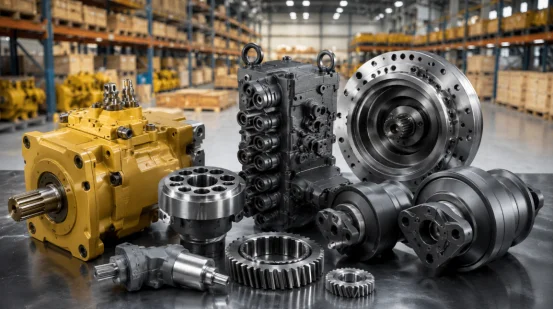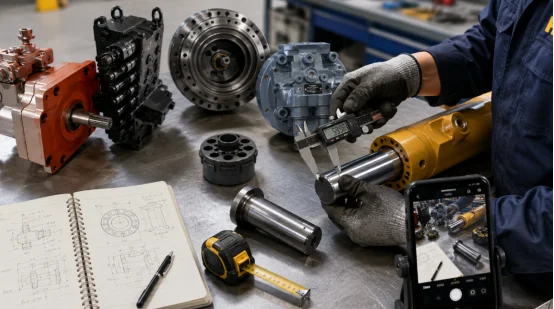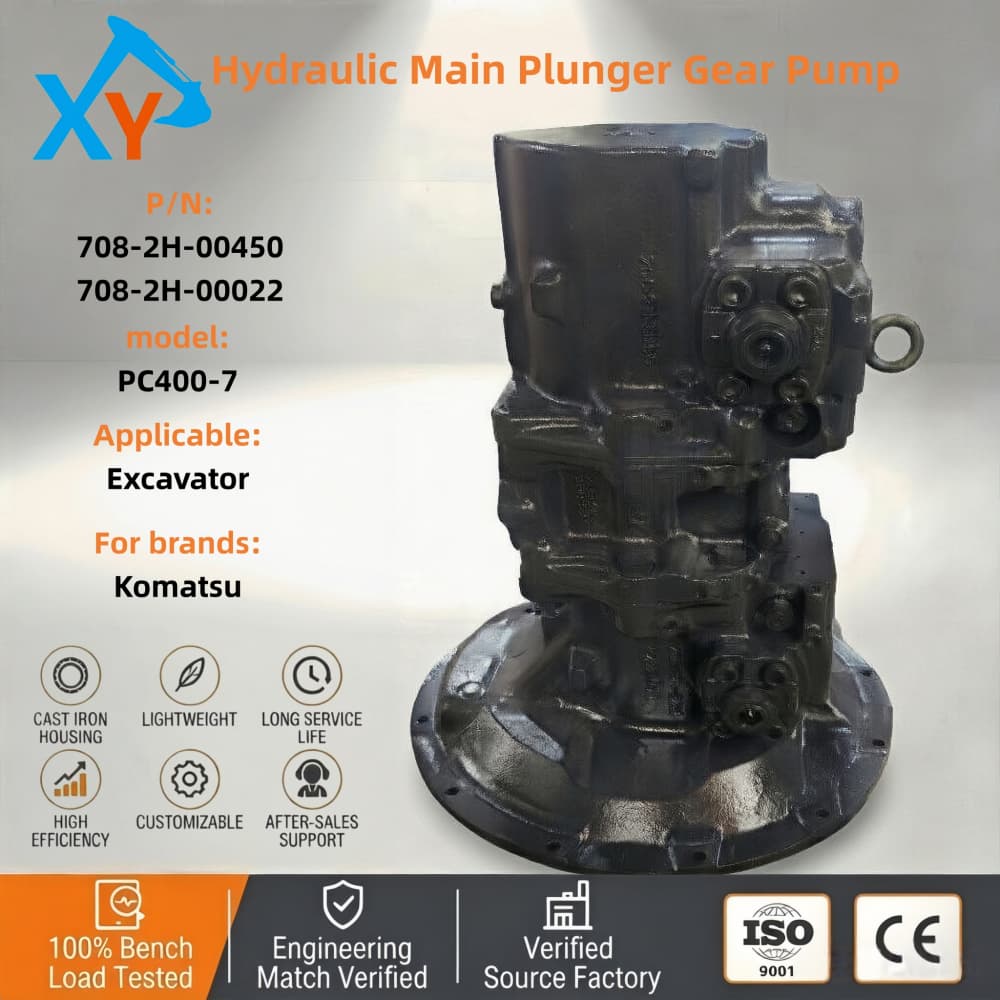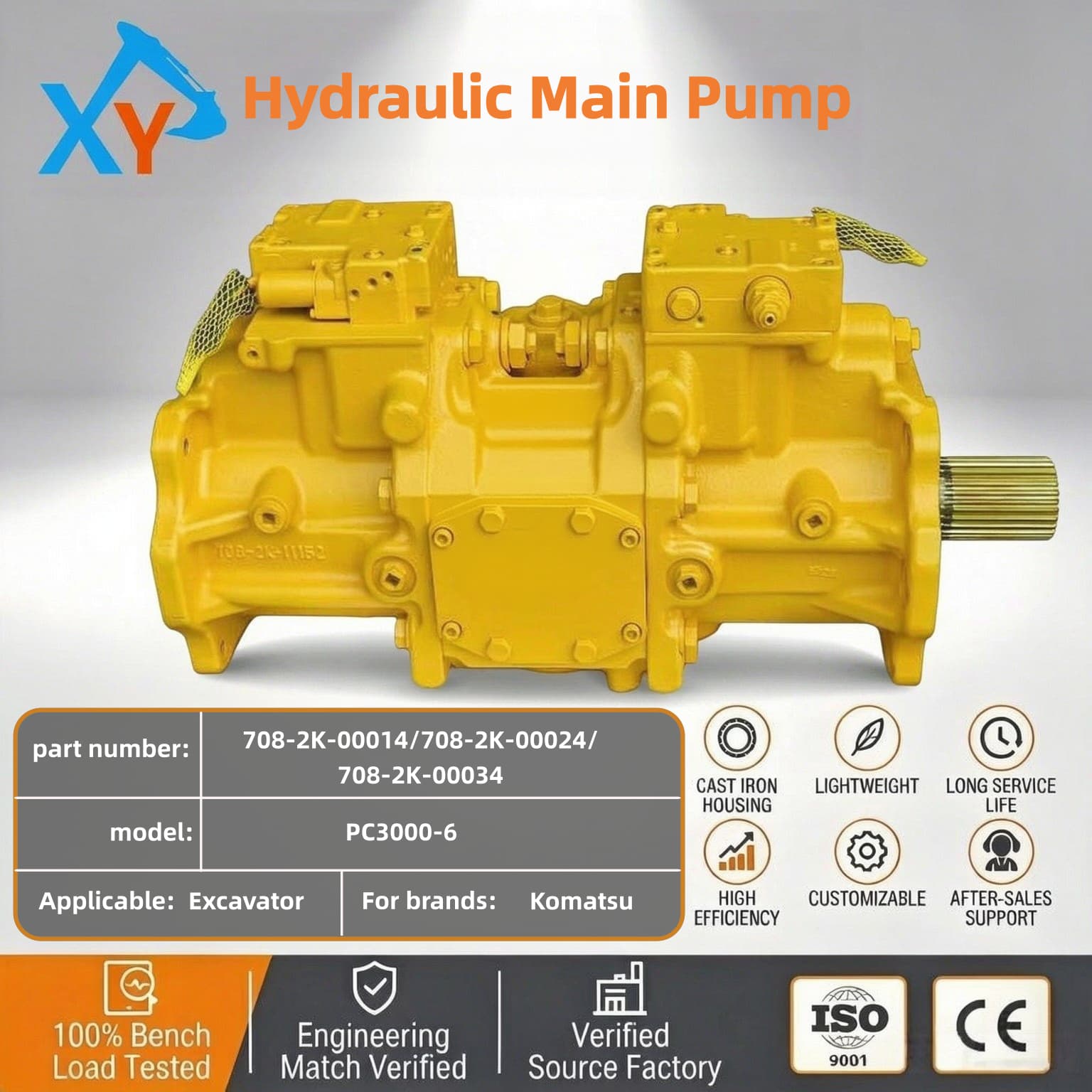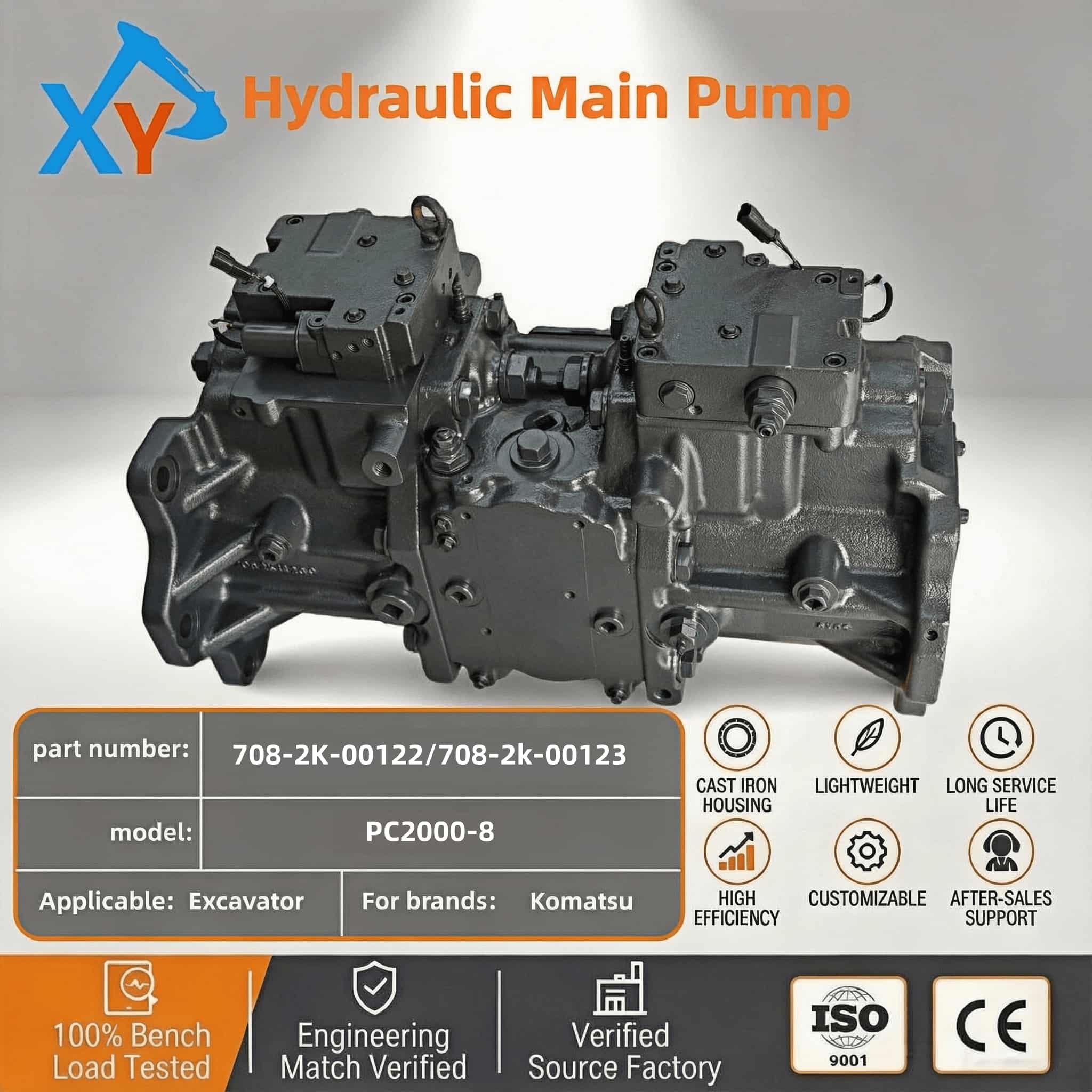
XINYA supplies excavator parts including hydraulic pumps, travel motors, swing devices, control valves, engine parts and undercarriage components. Send us your machine model, OEM part number or product photo for fast matching and quotation.
XINYA supplies excavator parts including hydraulic pumps, travel motors, swing devices, control valves, engine parts and undercarriage components. Send us your machine model, OEM part number or product photo for fast matching and quotation.

An excavator has many tiny pieces, but its core design relies on three big assemblies. These include the upper structure, the undercarriage, and the work equipment (or front attachment). These three excavator main parts handle separate tasks, even though they share hydraulic power and control signals. The upper structure provides power and handles rotation. The undercarriage moves the machine. Finally, the front attachment digs, lifts, and moves materials.
This simple breakdown makes inspecting the machine much easier. It also helps you track problems or order excavator replacement parts. For instance, a sluggish boom and a loud final drive sit in completely different assemblies. Therefore, they require totally different tests.
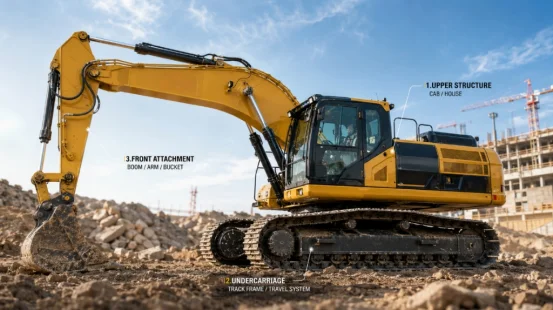
An excavator’s upper structure rests on the swing bearing. It holds the cab, engine, hydraulic pumps, control valve, hydraulic oil tank, fuel tank, counterweight, and swing device.
The engine runs the main hydraulic pumps. On a normal medium excavator, two variable displacement pumps send pressurized oil to different zones of the main control valve. Moving your joystick shifts the pilot pressure. This moves the correct valve spool, pointing oil toward a cylinder or hydraulic motor.
The excavator swing system lives here, too. Its axial piston motor powers a planetary reduction gearbox, changing fast speeds into a slower spin with massive torque. The gearbox output locks into the inner gear of the swing bearing, letting the house spin a full 360 degrees.
A wet multi disc parking brake normally holds the upper structure when the controls are neutral. Pilot pressure releases that brake when you operate the swing or front attachment. This small detail matters during fault tracing. A machine that refuses to swing may have adequate main pressure but no brake release signal.
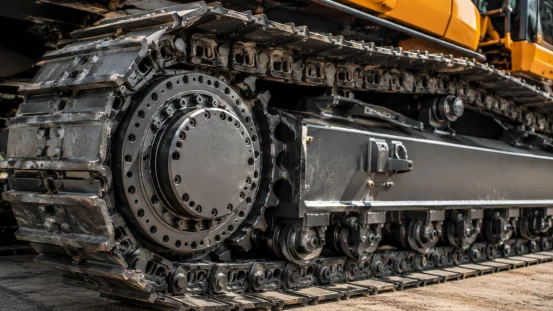
The undercarriage forms the base of the machine. Common excavator undercarriage parts include the track frames, track chains, shoes, rollers, idlers, sprockets, travel motors, final drives, and track adjusters.
Each excavator travel device combines a hydraulic motor, travel brake valve, and planetary reduction gears. Oil pressure turns the motor, the reduction gears multiply torque, and the sprocket pulls the track chain. Changing which motor port receives pressure changes the direction of travel.
The travel brake valve has several practical safety jobs. Its counterbalance valve smooths starting and stopping and helps prevent uncontrolled acceleration downhill. Relief and check valves limit pressure shocks and replace oil when the motor circuit risks cavitation. When you return the travel lever to neutral, spring force applies the parking brake automatically.
Track tension deserves attention too. Grease pumped into the adjuster cylinder moves the front idler outward and reduces track sag. Too much tension raises wear on pins, bushings, rollers, and final drive bearings. Too little tension makes a track more likely to derail. A little sag is normal.
The excavator front attachment consists mainly of the boom, arm or stick, bucket, connecting pins, links, and hydraulic cylinders. People often call this whole assembly the arm, though the arm is technically only the section between the boom and bucket.
The boom arm and bucket each make a different movement. The boom raises or lowers the attachment. The arm changes digging reach and pull. The bucket curls to cut, scoop, hold, and dump material. Cylinder size, attachment geometry, and hydraulic pressure all affect the force available at the cutting edge.
Attachment choice changes machine behavior. A narrow trenching bucket enters dense ground more easily than a wide grading bucket. A large bucket moves more loose material, but it also adds weight farther from the machine. That added load affects stability, cycle time, pins, cylinders, and the swing system.
The excavator parts and functions become clearer during one digging cycle. Each major assembly has to respond at the right time, sometimes while several movements happen together.
The excavator hydraulic system connects them. Pilot pressure carries your control input to the main valve. The two main pumps then send oil to the selected motors or cylinders. Return oil passes back through the control valve and oil cooler before entering the tank.
During a normal cut, the undercarriage provides a stable base while the boom lowers, the arm extends, and the bucket enters the ground. The bucket curls and the arm pulls inward. Two pump flows may combine to move the boom or arm faster. When the loaded bucket rises, one pump can power the boom while the other powers the swing motor. The house then rotates toward the dump point without moving the tracks.
Oil must also reach the travel motors while the house turns. A center joint at the swing center provides rotating oil passages, so the upper structure can rotate without twisting the travel hoses. Worn seals inside this joint can cause weak or uneven travel that is easily mistaken for a failing travel motor.
Wear usually appears where load, dirt, heat, and movement meet. On the front attachment, check bucket teeth, cutting edges, pins, bushings, cylinder rods, and hose joints. Excess pin clearance causes knocking and makes precise grading harder.
For the undercarriage, compare left and right track sag, inspect roller leakage, and look for sharp sprocket teeth or cracked shoes. Undercarriage wear can account for a large share of repair spending, so early measurements are far cheaper than running parts to failure.
On the upper structure, watch hydraulic oil temperature, pump noise, swing play, leakage, and warning messages. A slow attachment does not automatically mean the pump has failed. A restricted pilot circuit, sticking control spool, internal cylinder leak, or incorrect relief setting can produce similar symptoms.
Start with the machine model, part number, component photos, and the exact symptom. For hydraulic parts, also record whether the problem occurs hot or cold and during a single or combined movement.
Match the complete assembly and its internal specification. Two pumps may look alike while using different regulators. Travel motors can have different displacement settings, brake valves, or reduction ratios. Installing the wrong version may cause poor speed, excessive pressure, or mounting trouble.
You should also ask whether the item is new, OEM grade, aftermarket, rebuilt, or used. Check the warranty terms, test method, delivery condition, and available technical support. A very low quote loses its appeal quickly when a mismatched final drive leaves a machine idle on site.
A supplier covering all three assemblies can make part matching simpler, particularly when the original fault has not yet been isolated. XINYA supplies hydraulic pumps, control valves, swing devices, travel devices, engine parts, electrical components, and chassis parts through its excavator parts range.
Its capabilities include production, parts distribution, nonstandard customization, and support for genuine, OEM, and aftermarket options. Before shipment, technicians can verify a component through its part number or through clear photos and the machine model. The stated process also includes pre delivery inspection, product and packaging photos, international logistics support, and 6 to 12 month warranty coverage. These checks are useful for swing, travel, and hydraulic parts, where an external resemblance does not confirm internal compatibility.
Q1: What Are the Three Main Parts of an Excavator?
A: They are the upper structure, undercarriage, and work equipment or front attachment.
Q2: Is the Cab Part of the Undercarriage?
A: No. The cab sits on the upper structure with the engine, pumps, counterweight, and swing equipment.
Q3: What Parts Make Up the Front Attachment?
A: The main components are the boom, arm, bucket, cylinders, pins, bushings, and connecting links.
Q4: Why Can an Excavator Travel While Its Upper Structure Rotates?
A: A swing bearing supports rotation, while a center joint carries hydraulic oil between the rotating upper structure and the travel motors below.
Q5: Which Excavator Section Usually Wears Fastest?
A: The undercarriage often sees the heaviest wear because its tracks, rollers, idlers, and sprockets remain in contact with abrasive ground.